
Feb 23rd 2026
What Equipment Is Required to Be on a Boat Trailer
If you plan to tow your boat in or around Richmond MN, it is important to make sure your trailer has the proper equipment. A safe, legal setup protects your boat, your vehicle, and everyone else on the road.
At Channel Marine & Sports, we often answer questions about trailer requirements. While specific rules can vary by state, most boat trailers must meet basic safety standards. Here is a clear guide to the equipment you should have on your boat trailer.
1. Working Trailer Lights
Your trailer must have fully working lights that connect to your tow vehicle. These usually include:
-
Tail lights
-
Brake lights
-
Turn signals
-
Side marker lights
-
License plate light
Before every trip, plug in the wiring harness and test all lights. Faulty wiring is one of the most common trailer problems. Replacing a bulb or fixing a loose ground wire is much easier than dealing with a traffic stop or accident.
2. Safety Chains
Safety chains are required in most states. They act as a backup if the trailer disconnects from the hitch.
Chains should cross under the trailer tongue and attach securely to the tow vehicle. Crossing them helps create a cradle that can catch the tongue if it drops. Make sure the chains are strong enough for your trailer’s weight and not dragging on the road.
3. Proper Hitch and Coupler
Your trailer must have a coupler that matches the size of your hitch ball. Common sizes are 2 inch and 2 5/16 inch. Always double check that the coupler is locked and secured with a pin.
Using the wrong hitch size can cause the trailer to detach while driving. That can lead to serious damage and injury.
4. Trailer Brakes
Many states require trailer brakes if the trailer and boat exceed a certain weight. Larger boats and heavier trailers often need either surge brakes or electric brakes.
Brakes help reduce stopping distance and improve control, especially when towing at highway speeds. If your trailer has brakes, inspect them regularly and check brake fluid levels if applicable.
5. Breakaway System
If your trailer has electric brakes, it likely also requires a breakaway system. This system activates the trailer brakes if it becomes disconnected from the tow vehicle.
The breakaway cable should be attached separately from the safety chains. Test the system from time to time to make sure it works correctly.
6. Reflectors
Reflectors help other drivers see your trailer at night or in low light. Most trailers must have red reflectors on the rear and amber reflectors on the sides.
Even if reflectors are not specifically required in every case, they are an inexpensive safety feature that improves visibility. Check our trailers for sale in st. cloud area
7. Proper Tires and Wheels
Trailer tires are designed differently than standard vehicle tires. They are built to carry heavy loads and handle long periods of sitting.
Make sure your trailer tires:
-
Are rated for the correct weight
-
Have proper air pressure
-
Show no signs of cracking or dry rot
-
Have enough tread depth
Do not forget the spare tire. A flat tire at the side of the road is much easier to manage if you have a ready spare.
8. Winch and Safety Strap
The winch secures the boat to the trailer at the bow. It should be in good working condition, with no frayed straps or rusted cables.
In addition to the winch strap, many boaters use a separate safety chain or strap at the bow eye. This adds extra protection while towing.
9. Transom Straps
Transom tie down straps secure the rear of the boat to the trailer. These prevent the boat from bouncing or shifting while driving.
Make sure the straps are tight and in good condition. Replace any strap that shows signs of wear or fraying.
10. Registration and License Plate
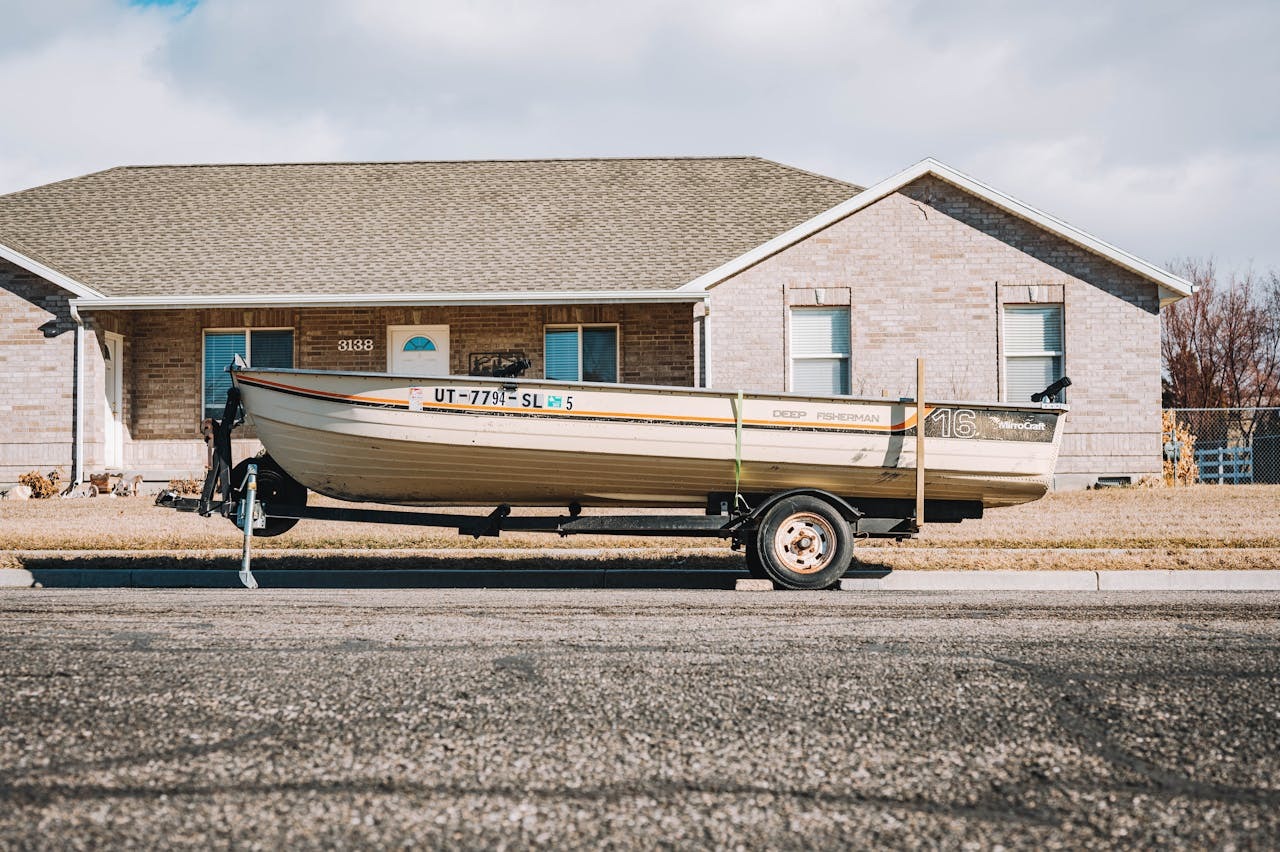
Your trailer must be properly registered and display a valid license plate, according to state law. Keep registration paperwork up to date and stored in your vehicle.
It is also wise to carry proof of insurance for your tow vehicle and boat. Read about How to Choose a Boat Lift
Pre Trip Safety Check
Before every trip to the lake, take five minutes to inspect your trailer:
-
Check lights and signals
-
Inspect hitch and coupler
-
Confirm safety chains are secure
-
Check tire pressure
-
Tighten all straps
A quick walk around can prevent bigger problems later. Read about how to trailer a boat with an outboard motor
Stay Safe on the Road
Towing a boat is different from driving a regular vehicle. Allow extra stopping distance, take turns slowly, and watch for sway. If your trailer begins to sway, ease off the accelerator and avoid sudden steering.
Having the right equipment on your boat trailer is not just about following the law. It is about keeping your family, your boat, and other drivers safe.
If you have questions about trailer setup, brakes, or parts, our team at Channel Marine & Sports is here to help. We want every trip to and from the water to be safe and stress free.